MemoHoney Official Website › Journal › Arginine Or Citrulline
Arginine Or Citrulline: Why One Goal Needs Two Amino Acids
Arginine is the molecule the body turns into nitric oxide. Citrulline is the molecule the body turns into arginine. That sounds like a pointless extra step, and it is the reason citrulline works better by mouth than arginine does — one of the genuinely elegant findings in supplement pharmacology, and one most labels get wrong.
The chain, in three steps
Nitric oxide is a gas the body makes on purpose. An enzyme called nitric oxide synthase takes the amino acid L-arginine and molecular oxygen and produces nitric oxide, with citrulline left over as a by-product. The gas diffuses into the smooth muscle wrapped around a blood vessel and relaxes it, so the vessel widens and more blood passes at the same pressure.
None of that is controversial. It is the chemistry behind nitrate sprays for angina, behind every drug in the sildenafil family, and behind the entire pre-workout shelf. The Nobel Prize for it was awarded in 1998.
So if you want more nitric oxide, supply more arginine. That is the logic behind four of the six ingredients in a great many memory and pump formulas, and the place it runs into trouble is not the chemistry.
| Step | What happens | How settled it is |
|---|---|---|
| 1 | Nitric oxide synthase converts L-arginine into nitric oxide | Textbook. Not in dispute. |
| 2 | Nitric oxide relaxes vascular smooth muscle and the vessel widens | Textbook. The basis of several drug classes. |
| 3 | Wider vessels deliver more blood to the tissue behind them | Textbook, at the level of a single vessel. |
| 4 | More blood to the brain improves how it works | This is the step that has not been shown. |
Three settled steps and one open one. The open one is the step every memory product in this family is sold on.
Why swallowed arginine mostly never arrives
Here is the part the sports shelf learned expensively in the 1990s. Arginine taken by mouth is attacked twice before it reaches the general circulation: once by arginase in the wall of the small intestine, and again by the liver. What survives that journey is a fraction of what was swallowed.
The consequence shows up directly in the dose literature. The 2022 dose-response meta-analysis found blood pressure moved only at four grams a day and above, and found nothing further above nine grams (the 2022 dose-response meta-analysis). An earlier meta-analysis of vascular function found the measurable benefit concentrated in people whose baseline function was already impaired (a 2009 meta-analysis of vascular function).
Four grams is a lot of arginine. It is also, on top of the losses, a fairly inefficient way to raise a molecule whose job is done in nanomoles.
- Arginase in the gut wall degrades a substantial share before absorption.
- The liver takes another share on first pass.
- Gram doses cause gastrointestinal complaints in a meaningful minority.
- Raising the dose past nine grams a day buys nothing further, so the ceiling is real.
- The people who benefit most are the people whose vascular function was worst to begin with, which is a pattern that recurs across nutrition research.
The detour that works
L-citrulline is not touched by arginase. It passes through the gut and the liver largely intact, reaches the kidney, and is converted there into arginine and released into the circulation. The molecule arrives by the back door, and the back door has no guard on it.
The study that established this gave healthy volunteers citrulline and arginine in a crossover design and measured plasma arginine and the arginine to ADMA ratio. The citrulline arm at three grams twice a day lifted the trough arginine concentration and improved the ratio; the lower citrulline arm did not (the 2008 pharmacokinetic study). Same goal, different molecule, better result.
This is a genuinely satisfying piece of pharmacology and it is why a thoughtful formulator picks citrulline over arginine. A label carrying both is either hedging or has not read the literature, and a label carrying two citrulline forms has at least understood which half of the problem matters.
- Arginine is the substrate, but it is destroyed before it arrives.
- Citrulline reaches the kidney intact and becomes arginine there.
- The dose that worked was three grams twice a day, which is not a capsule-sized number.
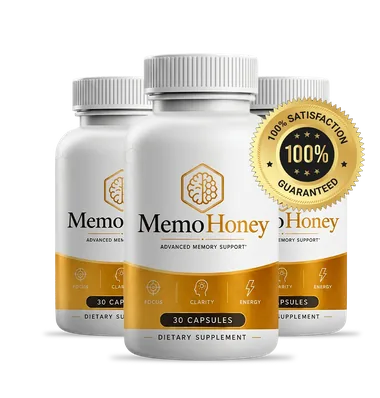
Two citrulline rows on the MemoHoney label
The formula picked the better molecule twice. What it does not print is how much of either, which the ingredients page works through in full.
Two bottles $158 · six bottles $294 · 60-day money-back guarantee
Order MemoHoney On The Official WebsiteOne capsule a day · 30 per bottle · lot MEM-26/ME-1612
Malate, AKG and the other decorations
Once a formulator has picked citrulline, the next question is which form, and this is where the marketing gets creative. Citrulline malate pairs it with malic acid, a Krebs cycle intermediate. Arginine AKG pairs arginine with alpha-ketoglutarate, another one. Both are sold on the idea that the partner molecule adds something.
The cleanest test of that idea is recent. A 2025 randomised crossover gave trained adults citrulline alone and citrulline with malate, matched on the citrulline content, and measured neuromuscular performance. The malate contributed nothing beyond the citrulline itself (the 2025 head-to-head trial of the two forms). A meta-analysis of citrulline malate and strength found a small effect overall, which the head-to-head suggests belongs to the citrulline half (the citrulline malate strength meta-analysis).
| Form | What it is | What the evidence suggests |
|---|---|---|
| L-arginine | The parent amino acid | Works at 4 g a day and up, inefficiently, because of first-pass loss |
| L-arginine AKG | Arginine bonded to alpha-ketoglutarate | Studied at 12 g a day; tolerated, with limited and inconsistent performance effects |
| L-citrulline | Converted to arginine in the kidney | The efficient route. 3 g twice a day moved the marker |
| L-citrulline HCl | A hydrochloride salt of citrulline | Same molecule; the salt fraction is weight that is not citrulline |
| L-citrulline malate | Citrulline with malic acid | The malate added nothing beyond the citrulline in a head-to-head |
Five rows, three underlying molecules. Naming more forms is not the same as having more ingredients.
The practical reading is that a label naming five amino acid forms is naming fewer distinct ideas than it appears to. Two arginines and two citrullines is two compounds delivered four ways, and the count of names on the front of a bottle is a poor guide to what is inside it.
There is one further wrinkle worth knowing, because it affects the arithmetic rather than the biology. A hydrochloride salt carries the weight of the hydrochloride, and a malate carries the weight of the malic acid. So a gram of citrulline malate at the conventional two-to-one ratio delivers about two thirds of a gram of citrulline, and a gram of the hydrochloride salt delivers less citrulline than a gram of the free form. A label that names the salt without stating the fraction has left a real number out, and on a label that states no amounts at all the point is moot but the principle still stands for every other bottle you compare it with.
What none of this has yet shown about thinking
Everything above is about blood vessels. The step from a wider blood vessel to a better memory is the one this whole family is sold on, and it is the one with the least support.
The most direct test available gave overweight and obese older adults escalating doses of nitrate-rich beetroot juice for thirteen weeks and measured cognitive function and cerebral blood flow directly. Neither moved (the thirteen-week cerebral blood flow trial). Dietary nitrate is a more reliable way of raising nitric oxide than any amino acid, so this is close to a best-case test of the mechanism, and it did not produce the result the category assumes.
One pilot trial in one population does not close a question, and the field has plenty of reasons to keep looking. But a reader choosing a blood-flow memory product deserves to know that the cleanest experiment on the idea has been run and reported.
How to read a label that names both
- Count the distinct molecules, not the ingredient names. Two arginines and two citrullines is two compounds.
- Look for an amount. Without one, nothing else on this list can be checked.
- Prefer citrulline to arginine if you are paying for one of them, on the pharmacology above.
- Treat malate and AKG as neutral rather than as an upgrade, on the head-to-head evidence.
- Check the format against the dose. Three grams twice a day is a scoop, not a capsule.
- Be sceptical of any cognition claim in this family until a trial shows the last step.
Applied to the capsule this website sells, that list gives a mixed answer, which is the honest one. The molecule choices are sound and the amounts are absent. The ingredients page sets out both halves, and the mechanism page follows the chain to the same place this article does.
MemoHoney is a dietary supplement for healthy adults aged 18 and over, with no FDA approval, and it is not intended to diagnose, treat, cure or prevent any disease. Arginine and citrulline lower blood pressure at gram doses, so anyone taking a blood-pressure tablet, a nitrate spray or a PDE5 drug should put this ingredient list with whoever prescribes them.
References
- Schwedhelm et al, Br J Clin Pharmacol 2008, vol. 65(1):51-9: Pharmacokinetic and pharmacodynamic properties of oral L-citrulline and L-arginine: impact on nitric oxide metabolism (PMID 17662090) https://pubmed.ncbi.nlm.nih.gov/17662090/
- Shiraseb et al, Adv Nutr 2022, vol. 13(4):1226-1242: Effect of l-Arginine Supplementation on Blood Pressure in Adults: A Systematic Review and Dose-Response Meta-analysis of Randomized Clinical Trials (PMID 34967840) https://pubmed.ncbi.nlm.nih.gov/34967840/
- Bai et al, Am J Clin Nutr 2009, vol. 89(1):77-84: Increase in fasting vascular endothelial function after short-term oral L-arginine is effective when baseline flow-mediated dilation is low: a meta-analysis of randomized controlled trials (PMID 19056561) https://pubmed.ncbi.nlm.nih.gov/19056561/
- Martín-Olmedo et al, Int J Sport Nutr Exerc Metab 2025, vol. 35(2):89-98: Malate or Not? Acute Effects of L-Citrulline Versus Citrulline Malate on Neuromuscular Performance in Young, Trained Adults: A Randomized, Double-Blind, Placebo-Controlled Crossover Trial (PMID 39662304) https://pubmed.ncbi.nlm.nih.gov/39662304/
- Aguiar et al, J Diet Suppl 2022, vol. 19(6):772-790: Effects of Citrulline Malate Supplementation on Muscle Strength in Resistance-Trained Adults: A Systematic Review and Meta-Analysis of Randomized Controlled Trials (PMID 34176406) https://pubmed.ncbi.nlm.nih.gov/34176406/
- Babateen et al, Nutrients 2022, vol. 14(5):1052: Incremental Doses of Nitrate-Rich Beetroot Juice Do Not Modify Cognitive Function and Cerebral Blood Flow in Overweight and Obese Older Adults: A 13-Week Pilot Randomised Clinical Trial (PMID 35268027) https://pubmed.ncbi.nlm.nih.gov/35268027/